
Generative Engine Optimization (GEO): How to Win AI Citations

Generative Engine Optimization (GEO): How to Win AI Citations
You search your own product category in ChatGPT. Three competitors get named. You don't. That gap between your SEO rankings and your AI visibility is exactly what generative engine optimization addresses.
Generative engine optimization (GEO) is the practice of structuring content so AI platforms like ChatGPT, Perplexity, Google Gemini, and Google AI Overviews cite and reference your brand in their generated responses. It's not a rebrand of SEO. It's a distinct optimization layer built for a discovery channel that didn't exist two years ago.
The stakes are concrete. When an AI Overview appears in Google search results, webpages experience a 34.5 percent lower average click-through rate than similar searches without an AI-generated summary. That traffic doesn't vanish; it gets absorbed by whichever brands the AI chose to cite. AI-referred sessions jumped 527% between January and May 2025, according to Previsible's AI Traffic Report. The shift isn't theoretical. It's already reshaping how prospects find, evaluate, and shortlist vendors.
This article breaks down the technical mechanics behind how AI engines select and cite sources, provides a measurement framework you can implement this week, and covers SaaS-specific implications that most guides skip entirely. If your content strategy still treats Google's blue links as the only discovery channel, you're optimizing for half the picture.
How Do AI Engines Actually Select and Cite Sources?
AI engines pick sources through retrieval-augmented generation (RAG), pulling content from indexed web pages at query time instead of relying on memorized training data. What this means for you: your content can get cited within days of publishing, not after some lengthy model retraining cycle.
That distinction changes everything about your approach to content optimization. Your blog post doesn't need to be baked into a model's training weights to show up in a response. It just needs to be discoverable and relevant the moment someone poses a question.
Two pathways feed content into AI responses. Training data is basically a static snapshot, often months old, that the model soaked up during its learning phase. Live retrieval works differently. Tools like Perplexity, Bing Chat, and Google AI Overviews actually search the web in real time. That's where GEO delivers immediate results. Optimized content can get cited within days instead of sitting around waiting for a model retraining cycle that might never specifically include your pages.
Selecting the right citations follows a five-stage pipeline:
- The AI engine breaks your natural-language query into a semantic format, converting intent into something built for database searching.
- The system then pulls documents from its index based on conceptual similarity, not exact keyword matching. Content about "generative engine optimization" might surface even if the user asked about "how to get cited by AI."
- Retrieved documents get scored on relevance, authority, recency, and structural quality.
- From there, the engine reads the highest-scoring documents and puts together a coherent response. It rephrases concepts in natural language instead of copying text word-for-word.
- It attaches citations so users can verify the information.
Stage three is where your GEO tactics either earn you citations or don't. It's that simple. Here are the specific signals AI engines evaluate during scoring:
- Topical authority: Does your domain show deep expertise across related subtopics, or is this just a standalone piece?
- Content structure: Headings, lists, tables, and clear hierarchies help AI parsers pull citable chunks from your pages more easily.
- Factual specificity: Named statistics, frameworks, and concrete definitions outperform vague generalizations every time.
- Recency: Content with current data gets priority. Outdated pieces fall behind quickly.
- Domain reputation: Backlink profiles and brand recognition still carry weight, though AI models don't weigh them the same way Google's algorithm does.
- Schema markup: FAQ, HowTo, and Article schema give AI parsers explicit context about what your content actually covers.
Here's what catches most SEO professionals off guard: the overlap between Google rankings and AI citations is way smaller than you'd think. Ranking #1 on Google doesn't mean AI will cite you. That's a hard pill to swallow, but the data backs it up. A well-organized page sitting on a lower-authority domain can actually outperform a thin page from a high-authority site when it comes to AI citation scoring. Why? Retrieval systems prioritize semantic density and extractability, two factors that traditional SERP algorithms don't explicitly reward.
How Does GEO Differ From Traditional SEO?
GEO optimizes for AI citation probability, not SERP position. It targets platforms like ChatGPT and Perplexity alongside Google's AI Overviews. The core content signals overlap heavily with traditional SEO, but the output format and how you measure success? Those are fundamentally different.

Most people will tell you to treat GEO as something completely separate from SEO. That framing just muddies the water. GEO is a progression, not a reinvention. It relies on the same principles that made traditional SEO work: topical authority, E-E-A-T signals, technical site health, and quality content. The real distinction comes down to what you're optimizing for and how you gauge success.
Keyword research still matters. So does internal linking. AI content best practices demand the same level of rigor they always have. But the output? That's what shifts. You're no longer writing content to earn clicks from a SERP listing. You're writing content that AI engines will extract, synthesize, and attribute back to you. It's a fundamentally different design constraint, and it changes how you approach every piece of content you publish.
Here's a stat worth paying attention to from Semrush's research: AI queries average about 23 words. Traditional search queries? Roughly 4. People aren't typing "best CRM" anymore. They're asking things like "What CRM should a 50-person remote sales team use if they need Salesforce-level reporting but simpler onboarding?" That jump in query length and specificity directly changes which content gets pulled into AI-generated answers.
| Dimension | Traditional SEO | Generative Engine Optimization (GEO) |
|---|---|---|
| Primary Goal | Rank on page 1 of search results | Get cited as a source in AI-generated responses |
| Target Platform | Google, Bing SERPs | ChatGPT, Perplexity, Google AI Overviews, Gemini |
| Content Format | Meta-optimized pages with click-worthy titles | Direct, citable answers with structured data and factual density |
| Success Metric | Click-through rate, ranking position, organic traffic | Citation rate, brand mention frequency, citation position |
| Keyword Role | Exact-match and semantic keyword targeting | Natural-language query alignment across conversational phrases |
| Link Value | Backlinks boost domain authority and rankings | Backlinks contribute to domain reputation scores used in retrieval |
| Content Structure | H1/H2 hierarchy, keyword placement, internal linking | Extractable chunks: definitions, stats, comparisons, named frameworks |
| Measurement Tools | Google Search Console, Ahrefs, Semrush | Manual AI querying, Semrush AI Visibility Index, Otterly.ai |
GEO is cumulative. You build it on top of your current SEO strategy by tweaking content format, boosting factual density, and adding structured data. A page sitting on page 3 of Google can still get cited as a primary source in AI responses, provided it's organized for semantic retrieval and packed with credible, specific information. The flip side holds true too: a page ranking #1 with thin, surface-level content might never show up in an AI-generated answer.
Teams that treat GEO as a separate silo? They'll end up doing the same work twice. But teams that bake it into their existing content workflow will see visibility compound across both channels.
What Are the Core Strategies for Generative Engine Optimization?
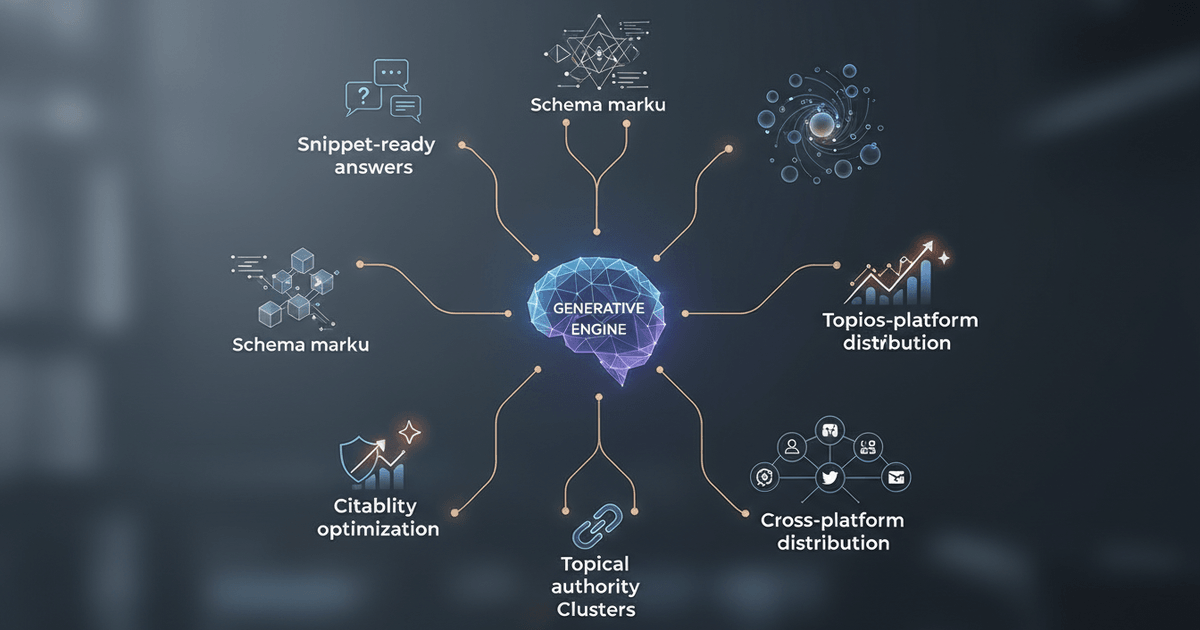
Six core GEO strategies drive AI citation: snippet-ready answers, schema markup, topical authority clusters, citability optimization, cross-platform distribution, and E-E-A-T signals. Here's the good news. Most content teams can layer these into their existing workflows without tearing everything down and starting over.
Understanding how AI engines gather and score content is helpful. But knowing what to do about it is what actually moves the needle. Here's a six-part framework you can apply to existing content this week.
1. Write snippet-ready answers. Start each section with a 40-to-60-word direct response to the question your heading poses. AI engines look for standalone, factual statements they can pull without stitching together info from multiple paragraphs. Think of it like writing the answer an encyclopedia would give, then layering in context underneath. If your opening paragraph needs three sentences of setup before it reaches the point, you've already lost the citation.
2. Implement structured data and schema markup. FAQ schema, HowTo schema, and Article schema give AI parsers clear signals about your content's structure and intent. Per HubSpot's GEO research, structured data makes content machine-readable in ways that improve how it gets selected during the ranking phase of retrieval. Without schema, you're forcing the AI to guess at your page's organization. With schema, you're handing it a map.
3. Build topical authority clusters. AI engines favor domains that demonstrate deep expertise across related subtopics. One article about "GEO" won't cut it. A domain covering GEO strategy, GEO metrics, AI citation mechanics, and platform-specific optimization across a connected cluster will outperform it every time. When you generate SEO articles with AI, plan them as clusters, not isolated pieces. Internal linking between those cluster pages reinforces the semantic relationship for both search engines and AI retrievers, signaling that your site owns the topic.
4. Optimize for citability. This is where most content falls short. AI models pull out specific statistics, named frameworks, definitions, and comparison patterns. A vague line like "many companies see improved results" gives the AI nothing worth citing. But a concrete claim like "companies implementing GEO saw a 30% increase in AI-referred traffic within 90 days" gives it something extractable. Every piece you publish should include named data points, original frameworks, and explicit definitions.
5. Diversify across AI platforms. Perplexity indexes and retrieves content very differently than Google AI Overviews. It prioritizes real-time web search and tends to cite recent, well-structured pages. Google AI Overviews, on the other hand, pull from its existing search index with much heavier weighting toward domain authority. Publish on your own domain for Google visibility, but don't stop there. Make sure your content is accessible and well-organized for independent AI crawlers too.
6. Strengthen E-E-A-T signals. Author bios with verifiable credentials, original research, expert quotes, and first-party data all boost your chances of getting cited. AI engines evaluate source trustworthiness before citing anything. Anonymous or unattributed content gets pushed down the priority list. Every page you want AI to reference needs a visible, credible author and at least one original data point. No exceptions.
The one thing all six strategies share? Specificity. AI engines won't cite content that hedges, generalizes, or repeats what ten other pages already cover. They cite content that gives them something concrete to attribute.
Why Does GEO Matter for SaaS and B2B Companies Specifically?
SaaS and B2B buyers increasingly use AI assistants for vendor research and shortlisting, making AI citation a critical early-funnel touchpoint that determines which products make the consideration set before a single sales conversation happens.
B2B purchase cycles run 6 to 12 months. During that time, a buying committee of five to eleven people conducts independent research, often starting with broad queries like "best project management tools for distributed engineering teams" or "how does tool X compare to tool Y." Those queries increasingly go to AI assistants instead of Google.
When a VP of Engineering asks Perplexity to compare infrastructure monitoring tools, the response typically names three to five vendors with brief descriptions of each. If your product isn't in that response, you're not on the shortlist. No amount of retargeting ads or outbound emails compensates for being invisible at the moment of AI-mediated discovery.
Tally, the bootstrapped form builder, provides a concrete example. ChatGPT became Tally's number-one referral source, driving more traffic than any traditional channel, and that result came from having well-structured, authoritative content that AI engines could easily retrieve and cite. For a small team competing against well-funded alternatives, AI visibility became the equalizer.
SaaS companies can apply specific tactics that go beyond general GEO strategy. Comparison pages ranking for "X vs Y" queries are prime citation candidates because AI engines frequently synthesize vendor comparisons. Structure these pages with clear feature-by-feature breakdowns, specific pricing data, and named pros and cons rather than vague marketing language. Feature documentation pages should answer the exact questions buyers ask: "Does X support SSO?" or "Can Y integrate with Salesforce?" Definitive glossary content for your category's key terms positions your domain as the reference source AI engines default to.
Publishing original benchmark data gives AI models something they can't find anywhere else. If you're the only source reporting that "the average onboarding completion rate for self-serve SaaS products is 37%," AI engines will cite you every time that topic comes up. Original data is the strongest GEO asset a SaaS company can build. SaaS founders scaling content programs already know this, which is why the ones investing in proprietary research are pulling ahead in AI citation rates.
There's a compounding effect at work here too. Once an AI engine cites your content for a query, subsequent queries on related topics become more likely to include your brand. The retrieval system builds an implicit authority profile for your domain across a topic cluster. Early investment in GEO creates a flywheel that gets harder for competitors to displace over time.
How Do You Measure GEO Success? Metrics and Audit Framework
GEO measurement comes down to four core metrics: AI citation rate, brand mention frequency, citation position, and query coverage. Teams track these through manual auditing and emerging tools like Semrush's AI Visibility Index and Otterly.ai.
With SEO, Google Search Console gives you impressions, clicks, and position data on a clean dashboard. GEO measurement? You're building your own tracking system from scratch. Standardized GEO analytics tools are still catching up, though dedicated platforms will likely show up within the next 12 to 18 months. Until then, the framework below gives you a solid baseline to work from.
| GEO Metric | What It Measures | How to Track It | Benchmark Target |
|---|---|---|---|
| AI Citation Rate | Percentage of target queries where your brand is cited in AI responses | Query each AI platform monthly, log yes/no per query | 25-40% for established domains; 10-15% for newer sites |
| Brand Mention Frequency | Raw count of brand mentions across AI platforms for your query set | Aggregate mentions across ChatGPT, Perplexity, Gemini, AI Overviews | Increase of 15-20% quarter over quarter |
| Citation Position | Whether you appear as primary source, supporting source, or footnote | Categorize each citation by position during manual audits | 30%+ of citations in primary position |
| Query Coverage | Percentage of your highest-value queries where your brand appears | Track coverage across your full query list per platform | 50%+ coverage for core product queries |
| Source URL Accuracy | Whether the AI links to the correct page on your domain | Verify linked URLs match your intended landing pages | 90%+ accuracy; flag mislinked pages for redirect fixes |
The audit follows five steps. First, pinpoint your 20 to 50 highest-value queries, the ones tied to buyer intent and your core product positioning. Then run each query through ChatGPT, Perplexity, Gemini, and Google AI Overviews. Keep the phrasing consistent so your results are actually comparable. Log citation presence, position, and the linked URL for every platform and query combination. Calculate your baseline citation rate and query coverage across all platforms. That's your score. Repeat monthly.
Semrush introduced an AI Visibility Index that monitors how often brands appear in AI-generated responses. Tools like otterly.ai and Peec AI offer similar tracking capabilities. They won't replace manual auditing entirely, but they cut down the grind of checking citations across multiple platforms.
The most valuable takeaway from your first audit won't be the aggregate numbers. It's the gap analysis: which high-value queries return zero citations for your brand? Those gaps become your content optimization priority list. A query where you're completely absent is a faster win than trying to climb from supporting source to primary source on one where you already show up.
Track changes after each round of content optimization. Say you restructured a comparison page in month one and your citation rate for that query jumps from zero to cited-as-primary by month two. That confirms your approach is working. If nothing moves after 60 days, surface edits won't cut it. The content probably needs a deeper structural overhaul.
What GEO Cannot Guarantee: Honest Limitations
GEO can't promise you specific AI citation placements. AI response generation is non-deterministic, meaning the same query can pull different source citations just minutes apart. Any vendor claiming guaranteed placements? They're selling the 2025 version of "guaranteed #1 Google rankings."

Try running the same query on any AI assistant twice in a row. You'll get different citations, different phrasing, and sometimes completely different recommendations. This isn't a bug. It's just how large language models operate. Temperature settings, context windows, and retrieval algorithm updates all introduce variability that no optimization strategy can fully account for.
That unpredictability hits hard if you're counting on SEO-like consistency from your GEO efforts.
Results compound slowly. You're looking at three to six months before citation patterns stabilize enough to draw real conclusions. AI engines need time to re-crawl your content, reassess authority signals, and pull your pages into their retrieval indices. Teams that audit after two weeks and declare GEO "doesn't work" are measuring noise, not signal.
Platform algorithm changes hit without warning. Google publishes core update announcements. AI search platforms don't. A retrieval weighting shift on any major AI engine could wipe out your citations overnight, and you won't get a changelog explaining why. Your only real defense? Diversify across platforms instead of optimizing for a single one.
The biggest misconception has nothing to do with timing or algorithms. It's the belief that GEO can create authority out of thin air. Content optimization amplifies signals your brand is already putting out: real expertise, genuine product-market fit, and domain authority you've actually earned. If your product doesn't solve a real problem, or your content lacks substance, no amount of GEO restructuring will trick an AI into citing you.
These limitations aren't reasons to skip GEO. They're reasons to treat it with practical expectations: a compounding investment in discoverability, not some switch you flip for instant visibility.
What Does a GEO-Optimized Content Workflow Look Like in Practice?
A GEO-optimized workflow tacks six extra steps onto your standard content process: query research, answer-first structuring, citability writing, schema markup, cross-platform distribution, and monthly auditing. Expect the added time cost to land around 20-30% per article, mostly front-loaded in planning and structure.
Most content teams already have a publishing workflow in place. GEO doesn't replace it. What it does is adjust specific stages so every piece you publish is structured for traditional search and AI retrieval alike.
Start with query research that goes well beyond keyword volume. Traditional keyword research surfaces terms like "best CRM for startups." GEO query research is different. It captures the conversational phrasing people actually type into AI assistants: "What CRM should a 10-person startup use if we need HubSpot-level features but can't afford enterprise pricing?" Record 30 to 50 of these natural-language queries per topic cluster, organized by buyer stage. Google's People Also Ask boxes and the auto-suggest behavior of AI assistants are your fastest sources for building this list.
Build every section around question-format headings paired with direct answers. Your first 40 to 60 words need to work as a standalone response, something an AI engine can pull out without any surrounding context. Think of them as micro-answers woven into a longer, more detailed article.
Citability gets built during the writing phase. Embed specific claims with real numbers attached. "Reduces churn" is invisible to AI retrieval. "Reduces monthly churn by 2.3 percentage points across a 90-day cohort" is extractable, quotable, and citable. Original data, named comparisons, and precise definitions all boost the odds that a retrieval system picks your content over a competitor's generic overview.
Technical optimization means adding Article schema and FAQ schema, keeping page loads under three seconds, and making sure your robots.txt isn't blocking AI crawlers. Here's the thing most people miss: several AI retrieval bots use completely different user agents than Googlebot. Check your server logs to confirm those bots are actually hitting your pages.
After you publish, submit updated sitemaps and confirm everything's getting indexed. Then push your content across platforms AI engines actually crawl: your blog, niche industry forums, and syndication partners. The best AI content tools can accelerate writing and structuring, no question. But query research and ongoing monitoring? Those still demand human judgment.
The most impactful change in this workflow? The answer-first structure. Teams that rework existing articles so each section opens with a direct, fact-dense answer tend to see citation gains faster than teams focused solely on publishing new GEO-optimized content.
Monthly auditing closes the loop. Pull up the metrics framework from the previous section to track citation rates, figure out which queries you're actually winning, and flag content that needs a refresh. It's the iteration that matters here, not nailing it on the first draft. That's what produces consistent AI visibility over time.
Pros and Cons of Investing in GEO Now
GEO investment offers early-mover advantages and compounds with existing SEO, but immature measurement tools and non-deterministic outcomes make ROI attribution difficult in the short term.

The strongest argument for starting GEO now is simple math. AI-referred website sessions grew by 527% in early 2025, according to multiple industry analyses. The brands establishing citation patterns today will own their category's AI responses by the time competitors start paying attention.
Tally's growth to $3M ARR on a tiny team illustrates the compounding effect of organic visibility done right. Now extend that logic: a bootstrapped team that builds consistent AI citations across every product-comparison query in their niche gains a distribution advantage that paid acquisition can't easily replicate.
GEO also layers cleanly onto work you're already doing. The strategies that drive AI citations (structured content, topical authority clusters, schema markup, E-E-A-T signals) are the same ones that improve traditional SERP rankings. You're not building a parallel content operation. You're adding a 20-to-30-percent optimization layer to your existing one, which keeps incremental costs low.
The honest downside: measurement is still rough. No single dashboard aggregates citation data across AI platforms the way Google Search Console does for organic search. Tracking requires manual queries, spreadsheet logging, and emerging tools that are themselves still in beta, and rOI attribution is even harder because AI citations don't generate clickable links in every response format.
Best practices are also a moving target. Strategies that produce citations today may lose effectiveness as AI platforms update their retrieval algorithms. But the alternative is worse: ignoring a discovery channel that's growing five times faster than traditional search means ceding those citations to competitors who won't ignore it.
Treat GEO as a three-to-six-month experiment with clear baseline metrics, not as a guaranteed ROI play. Layer it onto a solid SEO foundation. Measure relentlessly. Accept that some ambiguity in attribution is the price of being early to a channel that will define organic visibility for the next decade.
Frequently Asked Questions About Generative Engine Optimization
Is GEO replacing SEO?
No. GEO layers optimization for AI-generated responses on top of what already works. Keyword research, technical optimization, backlinks, and content quality still drive organic traffic from search engines. Think of GEO as extending your visibility into a new discovery channel, not replacing the one that's already delivering results.
Which AI platforms should I optimize for first?
Start with Google AI Overviews. Google still commands the largest search volume, so that's your biggest opportunity. From there, focus on whichever standalone AI search engines and conversational assistants are growing fastest. Content built around direct answers, schema markup, and specific claims tends to perform well across all major platforms, no platform-specific rewrites needed.
How long does it take to see results from GEO?
Three to six months for steady citation patterns to develop. Some tactical shifts work faster though: adding FAQ schema or reworking your existing headings into question format can trigger citations within weeks.
Can small businesses compete with large brands in AI citations?
Yes, particularly for niche queries. AI retrieval systems favor topical depth and content specificity over raw domain authority. Picture a 15-person cybersecurity firm publishing detailed, well-structured guides on container security. That firm can outrank a Fortune 500 tech company that only covers the topic in a single paragraph buried inside a broader article. Specificity wins every time.
Does schema markup help with GEO?
FAQ schema, HowTo schema, and Article schema give AI retrieval systems a clearer read on your content structure. Schema alone won't guarantee you get cited. But it does cut down the friction between what you've published and the extraction process AI engines rely on when selecting sources.
How is GEO different from Answer Engine Optimization (AEO)?
AEO focuses on featured snippets and voice search answers within traditional search engines, mainly Google. GEO goes further. It optimizes for citation across all AI-generated responses, including standalone AI search platforms and conversational assistants that operate entirely outside Google's ecosystem. Think of AEO as a subset of GEO, not a synonym.
Start Optimizing for AI Visibility Today
AI-mediated discovery is growing faster than any organic channel in the last decade, and the brands building citation patterns now will be the ones AI engines default to citing next year. Start optimizing for AI visibility with Wyrote and produce GEO-structured content at scale, from query research through structured publishing.


Ready to automate your SEO content?
Wyrote creates publish-ready articles from your keyword strategy.
Get Started Free