
We Got 200+ ChatGPT Citations: The AI Search Visibility Playbook

We Got 200+ ChatGPT Citations: The Brand Visibility in AI Search Playbook
Stop treating AI search like a future problem. Half of B2B software buyers now start their purchasing journey inside an AI chatbot, according to recent industry data, and that number jumped 71% in just four months. If your brand isn't showing up in those answers, you're invisible to a buyer segment growing faster than any channel since mobile.
We tracked every ChatGPT citation our content received over 12 months. Final count: 200+ citations across dozens of topic clusters. The patterns weren't random. They followed a repeatable set of content decisions any team can replicate, and this article lays out the eight plays that made it happen.
Google still dominates search by volume. That's not changing soon. But AI-generated summaries now appear in over 20% of Google searches, and AI search queries grew 527% year-over-year between early 2024 and early 2025. The result is a zero-click environment where your brand gets seen (or doesn't) before anyone touches a blue link.
The shift demands a dual strategy:
- Maintain traditional SEO for Google's organic results, where click-through traffic still converts
- Build citation-worthy content that AI answer engines pull into synthesized responses across ChatGPT, Perplexity, and Google's AI Overviews
- Track brand visibility in AI search as a standalone metric, separate from rankings and impressions
- Treat third-party mentions as a primary distribution channel, not a nice-to-have
Your presence in AI-generated answers isn't a vanity metric. It's the leading indicator of whether your next customer discovers you through an AI-generated recommendation or discovers your competitor instead. Two billion users encounter Google AI Overviews monthly. The question isn't whether to optimize for AI search, and it's how fast you can start.
1. How Does AI Search Decide Which Brands to Surface?
AI search engines pick which brands to cite based on third-party validation, topical authority, factual density, and structured formatting. Traditional ranking signals like domain authority? They don't carry the same weight here.
The RAG pipeline behind ChatGPT, Perplexity, Gemini, and Claude runs through three stages. It starts by converting a user's prompt into a semantic search query. From there, it pulls relevant content chunks out of indexed sources. Then it stitches those chunks into a single, coherent answer, choosing which brands earn a citation based on how strong and consistent the supporting evidence actually is.
What caught us off guard: your own website matters way less than you'd expect. Brands are 6.5 times more likely to be cited through third-party sources than through their owned domains. About 85% of brand mentions in commercial AI search come from external sites. That one data point alone should change how you distribute your content resources.
AI models prioritize agreement across sources. When three industry publications, two comparison articles, and a case study all reference your brand as a category leader, the model reads that as a strong signal. A single blog post on your own site making the same claim? It carries almost no weight by comparison.
The recent surge in AI visibility investment shows just how seriously teams are treating this shift. Research out of Princeton University (arXiv:2311.09735) found that content built with citation density, definition-lead formatting, and statistical enrichment can see up to 40% higher visibility in generative engine responses. Here's a detail most people miss: nofollow links correlate with AI visibility almost identically to dofollow links (0.509 vs. 0.504 Spearman correlation). That old strategy of chasing dofollow backlinks? It simply doesn't translate here.
| Factor | Traditional SEO Visibility | AI Search Visibility |
|---|---|---|
| Primary Goal | Rank on page 1 for target keywords | Earn citations in AI-generated answers |
| Ranking Signal | Backlink profile, domain authority, on-page SEO | Third-party mentions, entity consistency, factual density |
| Content Format | Long-form, keyword-optimized pages | Definition-lead, quotation-rich, structured for extraction |
| Success Metric | Position 1-10, click-through rate | Citation rate per topic, mention frequency across platforms |
| Traffic Model | Click-driven: user visits your page | Zero-click: user sees your brand in the answer itself |
| Update Cadence | Quarterly refreshes typical | Continuous publishing; recency correlates with reappearance speed |
Traditional SEO pays off when people click your link. AI search works differently. It rewards you for being trustworthy enough to get quoted directly.
2. Why the SEO-to-AEO Shift Changes Everything About Search Behavior
AEO (Answer Engine Optimization) is about earning AI citations through structured, quotation-ready content, not fighting for traditional search result positions.

Traditional SEO optimizes for a results page. AEO optimizes for an answer. That difference might seem small on the surface, but it changes how you approach content strategy, measurement, and where you put your budget. Think about it: when someone types "best project management tool for remote teams" into ChatGPT instead of Google, the AI doesn't serve up ten blue links. It gives one synthesized response, pulling from two or three sources. You're either cited in that answer or you simply don't exist for that query.
The typical recommendation is to treat AEO as a layer on top of SEO, bolted onto your existing keyword tactics. That's backwards. AEO demands a fundamentally different content structure. Keyword density, meta descriptions, title tag optimization? They have almost zero impact on whether an AI model decides to quote you. What actually matters is whether your content includes extractable, self-contained statements supported by concrete data. A 3,000-word article stuffed with keywords but missing a single quotable statistic won't earn a single AI citation.
SEO experts in 150+ countries are already tracking AI search visibility. That alone should tell you this isn't speculation. It's a real practice with dedicated tools and established measurement frameworks behind it.
The zero-click paradox is the hardest piece to wrap your head around. Brand awareness can surge while direct traffic tanks. Picture an AI model referencing your brand in 500 answers a day, yet not sending a single visitor to your site. If you're staring at Google Analytics, that looks like a loss. But here's the thing: when your branded search volume jumps 30% over that same window, those AI mentions are doing exactly what top-of-funnel marketing is designed to do. They're planting your name in the buyer's mind before the buying even starts.
Tracking this means changing what you actually measure. Branded search volume works as your proxy for AI-driven awareness. Compare it with AI citation frequency (covered in the measurement section), and the relationship becomes clear pretty quickly. Teams that write for AI citation patterns while still running traditional SEO end up capturing both channels instead of gambling on one.
If you're only optimizing for Google's organic results, you're ignoring a growing chunk of potential revenue. Every conversational query that skips the SERP entirely? That's a lost chance to be the brand the AI actually recommends.
3. How to Structure Content So AI Engines Actually Cite You
Content earns AI citations through definition-lead formatting, concise paragraphs of 50 to 150 words, direct-answer headings, and high factual density packed with specific numbers.
AI models don't read your content the way humans do. They're scanning for extractable chunks, self-contained statements that slot into a synthesized answer without needing surrounding context. Every formatting decision you make should serve that extraction process.
Start each section with a direct definition or answer. If your heading asks "What's topical authority?", define it in the first sentence, under 30 words. No warm-up, no filler. AI models pull disproportionately from the first 100 words beneath a heading, so front-load the good stuff. Put your strongest content right at the top. Keep paragraphs between 50 and 150 words. Longer blocks tend to get chopped up during retrieval, and the model might grab a mid-paragraph sentence that's missing all the context around it.
Question-based headings are your strongest ally. Organize content in pairs: a heading that mirrors a conversational prompt, then a paragraph that thoroughly answers it. This maps directly to how people actually phrase queries in ChatGPT and Perplexity.
Schema markup tells AI crawlers how your content is organized before they even start reading it. FAQPage schema for Q&A content, Article schema with author and publication date, Organization schema for entity consistency: each one cuts down on ambiguity about what your page actually covers. Think of structured data as metadata that says to the AI model, "This page definitively answers these specific questions."
The llms.txt file is a newer standard that's picking up steam. You place it at your domain root, where it tells AI crawlers about your brand's expertise areas, your preferred citation format, and links to your strongest content organized by topic. You can generate an llms.txt file for your site in just a few minutes. Think of it as a direct line of communication with AI models, giving them clear guidance on how your brand should be represented.
Formatting matters. But without precise figures, dates, and attribution phrases, even well-organized content gets overlooked. AI models are built to favor claims they can validate across multiple sources. "Our platform reduces churn" won't get picked up. "Churn fell 14% over six months across 200 accounts" gets cited.
Wyrote's content pulled in 200+ ChatGPT citations by sticking to specific patterns: definition-lead openings, question-based H2s, statistics with attribution in every section, and schema markup on every page. Citations clustered around pages with the highest factual density, not the longest word counts. Here's the kicker: pages averaging 12 data points per 1,000 words outperformed those with just 3 data points per 1,000 words by roughly 4x in citation frequency.
4. What GEO Tactics Drive the Most AI Citations?
Generative engine optimization earns AI citations by building third-party mentions, clustering topics strategically, creating comparison content, and publishing on a cadence tailored to each platform.

GEO lives one layer below your broader AEO strategy. Think of it this way: AEO is the goal (get cited in AI answers), while GEO is how you actually make that happen through specific content moves. After tracking citation patterns for a full 12 months, a few GEO tactics proved disproportionately effective.
Third-party mentions outperform everything else. The takeaway? Dedicate at least 40% of your content effort to building off-site presence. Guest posts on industry publications, contributions to expert roundups, spots in comparison articles, PR placements in trade media: all of these signal to AI models that your brand belongs in a given category. Even a single mention in a well-indexed industry report can spark citations across hundreds of AI-generated answers.
Topic clustering signals to AI models that you own a subject. Publish a pillar page on "content marketing for SaaS" backed by 15 cluster articles covering subtopics like distribution channels, editorial calendars, and ROI measurement, and the model starts recognizing a clear pattern of topical authority. Disconnected articles on random subjects? They won't build that signal.
Comparison content is citation gold. "X vs. Y" articles map directly to how users phrase their prompts in AI search. When someone asks ChatGPT, "Should I use Ahrefs or Semrush for keyword research?", the model pulls from pages that explicitly compare those tools. Your brand doesn't even need to be the main focus. If it shows up in those comparisons as a third option, you enter the citation pool for that entire query category.
Every AI platform has its own quirks. ChatGPT favors well-cited, long-form content packed with multiple references. Perplexity rewards freshness, so content updated within 30 to 60 days gets cited more often. Gemini pulls heavily from Google-indexed pages with strong schema markup, thanks to its deep integration with Google's knowledge graph. Claude tends to prioritize content that shows transparent methodology and clear data sourcing.
Content velocity ties everything together. AI engines re-index on a regular basis, and brands that publish consistently stay in the active citation pool. Drop 20 articles then go silent for three months? You'll lose ground to a competitor putting out four posts per week. The compounding effect of steady publishing on AI citation rates mirrors what we've long seen with traditional SEO and organic traffic growth. The difference here is the feedback loop moves faster.
5. How Do You Measure Brand Visibility in AI Search Over Time?
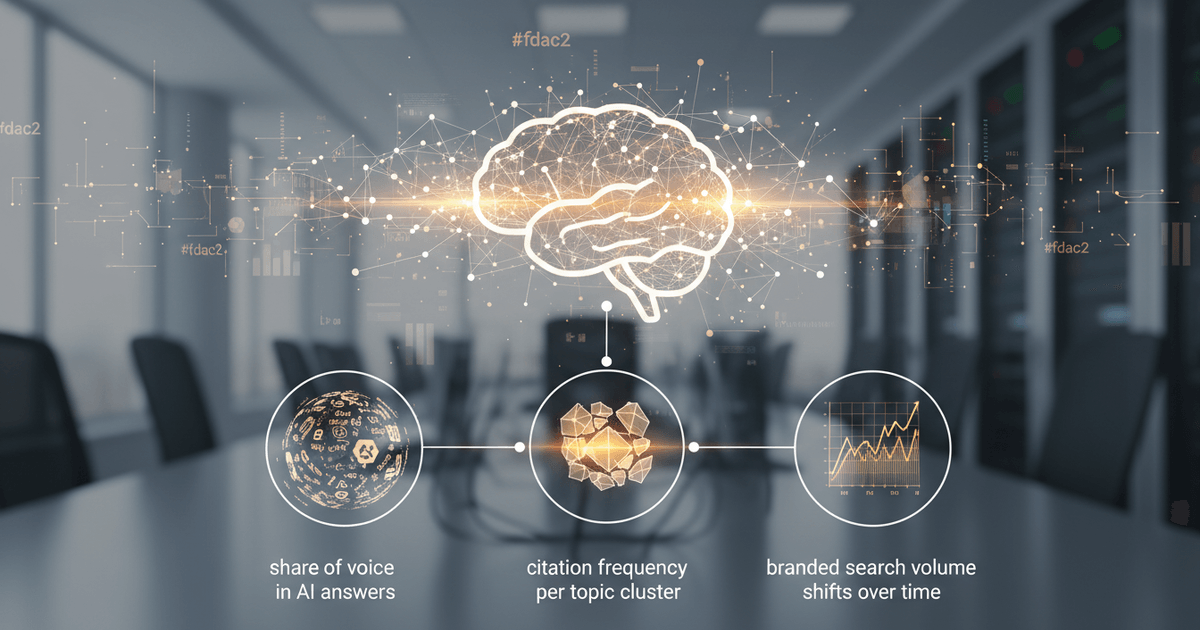
Measure AI brand visibility through three tiers: share of voice in AI answers, citation frequency per topic cluster, and branded search volume shifts over time.
Most teams default to counting raw mentions. That's a vanity metric. A brand mentioned once in a throwaway line of an AI answer and a brand cited as the primary source with a linked URL aren't the same thing. The distinction between mention and citation is where real measurement starts.
The first tier is AI Share of Voice: the percentage of relevant prompts where your brand appears compared to competitors. Run 50 to 100 prompts per topic cluster across ChatGPT, Gemini, Perplexity, and Claude each month, and log which brands appear, whether they're mentioned or cited, and in what position within the answer. This manual process takes time but produces the most accurate baseline. Platforms like Profound and Otterly automate portions of this tracking, monitoring mentions and citations across multiple AI models continuously.
The second tier is citation frequency per topic cluster, and share of voice tells you how often you appear relative to competitors. Citation frequency tells you which of your content topics the AI trusts most. If you're cited in 60% of "keyword research" prompts but only 5% of "link building" prompts, that gap reveals exactly where to invest next.
The third tier is branded search volume. This is your proxy for the zero-click awareness effect discussed earlier. Pull branded search data from Google Search Console monthly and correlate it with your AI citation tracking. A rising branded search curve alongside flat or declining organic traffic is the signature pattern of AI-driven brand awareness working in your favor.
| Metric | What It Measures | Tool / Method | Tracking Frequency |
|---|---|---|---|
| AI Share of Voice | % of relevant AI queries featuring your brand vs. competitors | Profound, Otterly, or manual prompt audits | Monthly |
| Citation Frequency | % of AI answers citing your content URL per topic cluster | Manual prompt audits with URL logging | Monthly |
| Branded Search Volume | Organic search demand for your brand name | Google Search Console | Monthly |
| AI Referral Traffic | Clicks from AI platforms to your site | Google Analytics with UTM parameters | Weekly |
| Zero-Click Awareness Index | Branded search lift minus AI referral traffic change | Calculated: Search Console + Analytics correlation | Monthly |
Set up a monthly cadence. Run your prompt audits in the first week, pull Search Console and Analytics data in the second week, and compile the three tiers into a single dashboard by mid-month. The brands that track this consistently spot citation drops before they become visibility crises. Citation rate per topic cluster is the metric that tells you where AI models trust your brand, and where they don't.
6. Why Agentic AI Is the Next Brand Visibility Battleground
Agentic AI systems autonomously complete purchases, bookings, and research tasks, selecting brands based on machine-readable data, API access, and aggregated trust signals.
Most conversations about AI search focus on chatbots answering questions. That's already yesterday's problem. The next shift is AI agents that don't just recommend your brand; they transact on your brand's behalf. An agent booking a restaurant, purchasing software, or selecting a vendor for a procurement shortlist isn't generating an impression. It's generating revenue.
This distinction matters more than most teams realize. When a shopping agent adds your product to a cart and completes checkout, that's a closed sale attributed to an AI system's autonomous decision. When a research agent includes your SaaS tool in a shortlisted comparison for a CFO, that's pipeline creation. The visibility-to-revenue gap that plagues traditional AI search optimization disappears entirely in agentic contexts because the agent's recommendation is the conversion event.
So how do agents decide which brands to select? The signals are fundamentally different from what conversational AI uses.
Agents prioritize machine-readable infrastructure over content quality. A beautifully written blog post won't help if the agent can't programmatically access your pricing, inventory, or product specs. Four signals dominate agent brand selection:
- API accessibility: agents need endpoints to check availability, place orders, and retrieve product data in real time. No API means your brand doesn't exist in the agent's workflow.
- Structured product data: standardized formats (JSON-LD product schema, Open Graph tags, consistent pricing feeds) let agents compare your offering against competitors without ambiguity.
- Review aggregation patterns: agents pull trust scores from multiple review platforms simultaneously. Fragmented or inconsistent review profiles reduce your selection probability.
- Entity verification: consistent NAP (name, address, phone) data, verified business profiles, and security certifications serve as the agent's shorthand for trustworthiness.
The common advice to "just improve your content for AI" misses the point entirely for agentic contexts. Content optimization is table stakes for conversational AI. Agentic AI requires infrastructure optimization: building API integrations, maintaining real-time data feeds, and ensuring your product information is programmatically accessible. A B2B company with perfect topical authority but no API layer will lose to a competitor with mediocre content and a well-documented developer portal.
Start by auditing your product data's machine readability. Can an external system query your pricing, features, and availability without scraping HTML? If not, that's your first priority, and build or document public API endpoints for core product data. Synchronize your entity information across every directory, review site, and business profile. Then begin monitoring which AI agent platforms (shopping assistants, procurement tools, travel planners) operate in your vertical, because each has different integration requirements.
This territory is almost entirely unmapped. The brands that build this infrastructure now will compound their advantage as agent-driven commerce scales.
7. What Does a Brand Visibility Audit for AI Search Look Like?
A brand visibility audit for AI search looks at eight specific areas: content structure, schema markup, llms.txt implementation, third-party citations, entity consistency, topic authority, platform indexing, and factual density.
Every team we've consulted on AI search optimization asks some version of the same thing: "Where do we actually stand right now?" No one has a solid answer. That's because a standardized audit framework for this channel simply doesn't exist yet. Conventional SEO audits look at backlinks, page speed, and keyword rankings. Those metrics tell you almost nothing about whether an AI model will actually cite your brand.
The audit below covers eight categories. Rate each one from 1 (not implemented) to 5 (fully optimized). A total score under 20? That means critical gaps need immediate attention. Between 20 and 35, you've got a foundation in place, but there are significant blind spots holding you back. Score above 35 and you're outpacing most competitors, so shift your focus to platform-specific optimization.
| Audit Area | What to Check | Status (Y/N) | Priority If Missing |
|---|---|---|---|
| Content Structure | Definition-lead paragraphs, 50-150 word sections, direct-answer headings on 80%+ of pages | High | |
| Schema Markup | FAQPage, Article, Organization, and Product schema deployed and validated in Rich Results Test | High | |
| llms.txt File | Deployed at domain root with brand mission, expertise areas, and links to authoritative content | Medium | |
| Third-Party Citations | Brand mentioned in 10+ external publications annually with contextual links | High | |
| Entity Consistency | Brand name, logo, contact info identical across all directories, schema, and on-page mentions | High | |
| Topic Authority Coverage | 5+ pillar pages with 10+ supporting cluster articles each, connected via internal linking | Medium | |
| AI Platform Indexing | Content confirmed accessible to AI crawlers (no robots.txt blocks for GPTBot, ClaudeBot, PerplexityBot) | Critical | |
| Factual Density | Sourced statistics, specific numbers, and verifiable claims in 70%+ of content sections | Medium |
The most frequent mistake brands make isn't skipping one of these areas. It's assuming that solid traditional SEO performance means you're ready for AI. A site with high domain authority and thousands of backlinks can still score below 15 on this audit if its content relies on long narrative paragraphs without extractable statements, lacks schema markup, and has never published an llms.txt file.
Another common oversight: completely ignoring non-search AI platforms. Teams fixate on one or two AI models while three others can't even crawl their content. Go check your robots.txt file for GPTBot, ClaudeBot, and PerplexityBot directives right now. If any of those bots are disallowed, you're invisible on those platforms, and content quality won't save you.
Thin content is the silent killer. Pages with fewer than 300 words, vague descriptions, or copy that could belong to any competitor in your space simply won't get cited. AI models require content with enough specificity and solid factual grounding before they'll extract anything. Product pages that read like brochure text? They get skipped every time.
Run this audit every quarter. AI models refresh their training data and retrieval indexes on rolling schedules, and your competitors aren't sitting still. A score of 35 today can easily slip to 25 within three months if you're not maintaining freshness and broadening your topical coverage. Assign ownership for each audit area to a specific team member so nothing falls through the cracks.
8. How to Connect AI Search Visibility to Revenue (Not Just Impressions)
AI search visibility connects to revenue through a five-stage cycle: AI citation, branded search lift, site visit, pipeline entry, and closed deal.

Counting how many times an AI model mentions your brand is like counting how many people saw your billboard. It feels productive. It isn't. The brands winning in AI search can trace a citation back to a closed deal, and that requires a different attribution model than most marketing teams currently run.
The revenue cycle works like this. An AI citation creates brand awareness in a context where the user already has high purchase intent (they asked a specific question). That awareness triggers a branded search on a traditional search engine, which you can track in Search Console. The branded search leads to a site visit, where the user engages with conversion-focused content, and from there, standard pipeline metrics apply: demo requests, trial signups, contact form submissions, and eventually closed revenue.
Tracking this cycle requires connecting three data sources. First, correlate your AI citation frequency (from your monthly prompt audits) with branded search volume trends in Search Console. If citations increase by 30% in March and branded searches rise 20% in April, you've identified the leading indicator. Second, create dedicated landing pages with UTM parameters specifically for traffic arriving from AI referral sources, and both major AI platforms now send identifiable referral traffic that shows up in analytics. Third, tag these visitors in your CRM so you can follow them through the pipeline and attribute closed revenue back to the AI visibility channel.
Paid search within AI environments is a near-term reality that almost nobody is preparing for. AI platforms are experimenting with sponsored placements inside generated answers. Ansira has flagged this as an emerging channel for local businesses, and the logic is straightforward: if AI answers replace traditional SERPs, the advertising dollars follow. Teams running paid search campaigns should start earmarking 5-10% of their budget for testing sponsored AI citations as these programs launch.
Local businesses face a distinct opportunity. AI-powered local recommendations pull from business profiles, review aggregation, and location-specific content. A restaurant with 200 reviews, consistent NAP data, and menu schema markup will get recommended over a competitor with better food but a bare-bones online presence. Local brands should treat their AI visibility optimization as seriously as they treat their Google Business Profile.
The attribution is actually cleaner than most awareness channels. Unlike podcast sponsorships or conference booths, AI citations generate trackable branded search spikes within days, not months, and the compounding nature of AI visibility (models reinforce citations from sources they've cited before) means the ROI curve steepens over time. Waiting 12 months to start means competing against brands with a year's worth of compounded citation authority. That gap is expensive to close.
Frequently Asked Questions About Brand Visibility in AI Search
How is the shift from SEO to AEO affecting search behavior?
People now type full questions and conversational prompts, not fragmented keywords. They expect one synthesized answer, not ten blue links. This shift forces brands to compete for citation placement inside a single generated response. Ranking on a results page matters less than getting quoted in the answer itself. Zero-click interactions have grown substantially because AI-generated answers satisfy user intent without requiring a click-through.
How do I improve brand visibility in AI search engines like ChatGPT and Perplexity?
Build topical authority through content clustering. Implement schema markup (Article, FAQ, Organization) and increase factual density with sourced statistics. Earn third-party mentions on authoritative sites, and keep your entity information consistent across every platform. The eight plays covered here give you the full tactical framework.
Can you track how often your brand is cited by AI search engines?
Yes. Tools like Profound and Otterly automate citation tracking across major AI platforms. For manual audits, run 50-100 prompts per topic cluster each month. Log which brands show up, where they rank, and whether they get a linked citation or just a mention. Then correlate those findings with branded search volume in Search Console to validate the trends you're seeing.
What is the difference between traditional SEO and AI search optimization?
Conventional SEO focuses on ranking algorithms to drive click-through traffic from a results page. AI search optimization is a different game entirely. It targets retrieval systems that pick sources for inclusion in generated answers. Your success metric shifts from "rank position" to "citation frequency." Content formats change too, moving away from long-form narrative toward extractable, definition-lead statements packed with factual density.
Does structured data and schema markup help with AI search visibility?
Schema markup gives AI crawlers a clearer picture of entity relationships, content types, and factual claims. FAQPage, HowTo, Article, and Organization schema all boost your chances of being retrieved. Pair that schema with an llms.txt file at your domain root and you create a dual signal: structured metadata for crawlers, plus explicit instructions telling AI models how to cite your brand.
How will AI agents affect brand visibility in the future?
AI agents that independently buy, book, and research on behalf of users will pick brands based on API access, machine-readable product data, and trust signals pulled from review sites. That reality turns visibility into a product-engineering problem, not a marketing one. Smart brands should be building documented API endpoints right now. Real-time data feeds for pricing and availability aren't optional if you want to stay visible once agent-driven commerce hits scale.
Start Building Your AI Search Visibility Playbook
Every month you delay, competitors accumulate citation authority that compounds against you, and if you scored below 20 on the audit above, start with content structure and schema markup. If you're above 35, shift focus to agentic readiness and revenue attribution.
Start your AI visibility playbook with Wyrote and stop ceding ground to brands that started earlier.


Ready to automate your SEO content?
Wyrote creates publish-ready articles from your keyword strategy.
Get Started Free